Showing posts with label walks. Show all posts

Sunday, July 7, 2013

July 24 Hunting Woolf near Brighton

Towards Brighton.  Ditchling Beacon, Monks House (V Woolf etc),  Charleston House (more Bloomsbury), Brighton

I started off with a run to the West of the lifeboat station.  To my surprise I found lots of exposed sand a few hundred metres into the run.  It turned out to be quite good running, although the frequent groynes made it a bit challenging at times.  
After getting to the Coast Guard tower – effectively at the edge of the huge caravan Park – I turned back inland and found a nice old village: the folk who lived there must have hated the appearance of the caravan park.

I decided to go back with my binoculars to check for waders and my camera to photo algae 
( especially that growing on the groynes).  
There were few birds, possibly because the dog-walkers were  out in large numbers.  I asked one of them if the sand was usual and apparently it was: this just seems to have been the first time I have been there at this stage of the tide.  She commented that the area where we were was often lined with  Twitchers in the migration season, and certainly Selsey Bill is mentioned as a good sea watching spot in my 'Where-to' book.  In a subsequent conversation I was told about 'Mr Seal' who is often seen in the afternoon in this area.

After breakfast we took off to the East along the A27.  This seems to be one of the two trunk roads South of the Thames (the other being about 20miles North). so if you wish to drive East- West or vice versa this is effectively the only game in town.  It is fine while 2 lanes each way (although tail-back can arise rapidly at roundabouts) but when you get to places like Worthing - which ended up being nominated, and elected as the place on this trip most likely to get the tube when the earth is given an enema - where the road drops back to 1 lane it becomes stop start even in the middle of the day.  At one point there were signs about road works, but it appeaered that rather then carving an additional lane out of the 4m wide nature strip they were making a garden!   I was amused by the name of this area which appeared to be Sompting (faith and begob, to be sure!). 

We found the small road to Devils Dyke which was our first objective for the day.  I wondered why these geological features are always called Devil's?  'Perhaps it is because they are usually downwards orienting – I shall have to check for mountains etc where the name refers to god! In the 3 or 4 miles from the highway to the site we passed 2 golf courses – a little devoid of trees but with brilliant views over to the Channel .  The walk alongside the Dyke was very pleasant.  Apart from the Dyke itself
there were lots of flowers and insects, some photographs of which are in the thematic pages below.  Towards the end of the walk we found a few rabbits – the first since Brum -  and a bouncy fox.  The latter caused me to think that I have yet to see a dead badger, whereas on our previous trip, not that far West, the roads were lined with potential shaving brushes.  Has the infamous cull had an effect already?  (Roadkilled badgers did appear in Shropshire and I was told that the cull was now a test project being undertaken near Cirencester.)

This walk was part of the South Downs Way which is one of the Long Walks that have been developed in the UK.  Several of the other punters we crossed  with seemed to be carrying packs for serious walking. 

Our next objective, Ditchling Beacon, was also on this route.  At the car park was a NT notice 
explaining that this area had been given to the Trust in memory of a WW 2 pilot who had lost his life in the area, which made me realise that this was looking over the Weald where much of the Battle of Britain took place.  There were great views from the Beacon, 
which was the reason it was a beacon, so that the bonfires could be seen from a long way off (if, for example a bunch of supporters of the Real Madrid Bowls Club were spotted on the horizon). Again there were many flowers but no orchids (a photographer told us they had 'gone over' in this area). 

We then trotted off to Lewes from where we headed to Rodmell to check out the Monks House,  at  one time the abode of Virginia Woolf VW - such usage in this post refers to her, not our car!).  Parking was an issue (as everywhere) but we managed.  
A head of VW 
was in the garden of the Manor referring to the place where her ashes had been placed under an old elm tree (rather than the magnolia in situ).   Apparently the elm trees were long gone and the plaque had been shifted to a different position.  There were a lot of interesting things made by members of the Bloomsbury Set around the house   This portrait of VW
was done by her sister, Vanessa.  As usually seems to be the case with NT the volunteers were very helpful and interesting.  In one room there were a bunch of books but only a few, VW's set of Shakespeare  were original.  At some point Leonard Woolf's library of some 7,000 volumes had been sold to Washington State U so had been replaced by some “books by the metre” samples to fill the shelves!

The village of Rodmell was full of interesting looking houses as exemplified by the Rectory.
The small stall seems to be some locals raising money for their village projects.

Our final stop was Charleston Farmhouse which was also linked to the Bloomsbury's.  This is run by a Private Trust rather than NT.  When we got there found we had to do a tour – for which we would have to wait for an hour and a half, so we passed on that and just had a look round the garden.  It is surprising that they talked about the place being unusually busy while the car park wasn't full: I suspect more private sector jobsworthiness.    We were allowed to go and look at some posters one of which included a "family tree" of the Bloomsbury Set.  If you click on this image to see it larger you will understand why there are quotes around the word family!  
The drive home was OK,as far as anything involving Worthing can be "OK", with good views pf Arundel Castle and Cathedral from the highway.

On the way Frances commented on the number of Ford Transits we were seeing on the way.  So it was interesting when we got home to hear that the Transit factory was closing.  On the breakfast program the next day they commented that the production was shifting to Turkey and there would be no Ford production in the UK.

Frances and I trotted off to look for Mr Seal.  As we approached the designated area I noticed a large grey lump on the beach.
This was Mr Seal and a guy wearing a polo shirt announcing he was a Mammal watcher (or similar) explained that its name was Trevor
and it was somewhat controversial since he has been known to bite folk who behave stupidly around him.  He just lay around peacefully while we were there, and all the punters were well behaved – possibly because an official was present.


On the way back I noticed a Heritage sign about Gibbet Field.  An English form of 'Encourager les autres”.  I also remembered to photograph one of the yuccas growing in a garden near the cottage. 

Beers: Freeminer ”GoldMiner”  Normal pleasant bitter;  Shepherd Neame “Spitfire – fuller boided and very pleasant.  Labelled “The Bottle of Britain”with photos of a couple of RAF types.

Bird of the Day: Yellowhammers at Ditchling
Building of the day: Rodmell rectory
Garden of the Day: The Monks House
Bad taste of the Day: Waiting for tours at Charleston Farmhouse
View of the Day: Devils Dyke, narrowly over Ditchling Beacon

Back to the Index page

july 25 Up the Downs

Hazelmere (Black Down), Selborne

I decided to go for an early walk to see what was around on the sand.  Although only just past 6 some folk were out walking dogs.  One of them was a very affectionate whippet which certainly stirred up the gulls a tad.

On the way back I photographed a very pleasant little garden in Albion Street, created on someone's nature strip. (The RH sign on the fence features later in this post.)
Next step was to show Frances the old part of Selsey and the holiday park.  This was achieved with no drama.  
Note the (relatively good) amount of space between the vans.
We then went to have a look at the village church – St Peters.  As there was a service going on we didn't go in.  I did notice that the War Memorial listed 57 dead in WW1, at which time the population would seem to have been about 1500: an extraordinary proportion.

On to Pagham Harbour at St Wilfrids.  As we walked round to the spit it emerged that the sea front side was all streng verboten because of nesting terns.  The RSPB fails on issuing good warnings since if there hadn’t been a worker there doing some surveys I would have wandered right in to the restricted area.  However we found a good crop of Ringed Plovers (a bit camouflaged in the image) and Dunlins on the beach
and more of them plus masses of Oystercatchers (20+) and Little Egrets (6+) on the mud in the lagoon.

On to Midhurst which I thought would be an attractive little village.  In fact it was rather boring so we carried on towards Hazelmere and Black Down.  The latter was easy to find, and rather attractive.  However there were no signs at all for Black Down so we instituted spiral theory, which requires getting into the approximately correct area and then continually turning right (or left, as seems appropriate).  I eventually spotted a local sweeping his drive.  (Since a Ferrari was visible in the garage I guessed he wasnt a member of the starving poor.) 

He was a member of The Helpful however and confirmed both that we were on the right road and that the signage was crap.  On, on.  As promised, so it was delivered.  I couldn't remember why we were attracted to this site – other than it being marked in our Road Atlas – but it was an excellent walk though mixed forest 
and heath to the Temple of the Winds where Wordsworth used to hang out looking over The Weald when not fantasizing about daffodils.  Apparently - according to Country Life, which is hardly an organ of the Left, -  if the Government gets its way this view is going to acquire  a bunch of fracking facilities.   Shime, shime David Cameron: and what is Nick Clegg doing about this.
We spoke to a few locals to confirm directions as we had no map and my internal compass (I think driven by the position of the sun) is buggered in the Northern Hemisphere.  I was impressed by the periodoc sighting of fire beating flails hanging up for general use
Getting back to the car it looked to be too much time and messing about to go to Selborne: I shall continue to read the book by Gilbert White which had got the place on the list.  So we rumbled off back  to Selsey where I went to the library to see if they had wifi.  Yes they did – installed the previous day- and I used it.  The first to do so!  It then emerged that some toe-rag - see, I can still speak English despite having moved about 43 years ago -  had hijacked my gmail account – I suspect from Kuala Lumpur airport  - but Google had recognised this and suspended my account greatly to the concern of some readers of my blog!  Hopefully it has been fixed.

I dropped back into the Church – which part at least had been moved from Church Norton and no service was evident.  The most interesting things were the collection of labelled rock on the altar
 and the table of chief religious persons running it from St Wilfrid in 681 CE to date (with a gap from 1070 to 1324 presumably while the Normans got their act into gear).

We have wondered what the Selsey Anglers Club does for its members.  It seems to be two things:
                     provides winches to drag their boats up the single to the promenade; and
                     offers a spot to store the boat over Winter.

For this they charge demographically interesting fees:
                     Regular (ie blokes):'£15 joining fee and £15 a year
                     Ladies (ie sheilas) £10 joining fee but no annual subs
                     Juniors (ie rugrats) No joining fee and $5 a year

As this marks the end of our stay in Selsey I'll put in a couple of general images also.  First, a couple more dog poop signs: given the number of pooches around I can see why reminders are a good idea.


Another amusing approach to this problem is being used in Spain.

Trevor was not available this evening and I cannot remember what beer I tasted (but am sure there was not an excessive amount of it!

Bird of the Day: Dunlin in breeding plumage
Building of the day: Bakery in Selsey
Garden of the Day: Little one by the transformer in Albion St
Bad taste of the Day: lack of signs to Black Down
View of the Day: The Weald from the Temple of the Winds

Back to the Index page

July 27 The reason for this expedition.

A walk from Diddlebury and a wedding.  (The latter rather than the former being the reason for the trip.)

For some reason I had a really crappy nights sleep.  No idea why but I survived the day OK so, to quote Buddy Holly, I guess it doesn't matter anymore.  Here are a couple of images of Tugford Farm where we are residing for the next week.  For some reason our car is parked in front of the other cottage!

The place was very comfortable and the hosts excellent.  Strongly recommended

Once we were awake and breakfasted we took off on a reconnaissance for the wedding we were attending in the evening (which is mainly why we were in the UK and certainly why we were visiting Shropshire).  Wyndham had offered two routes from Tugford to Henley Farm:

  •  the easy one (to the main road and then to Craven Arms and then on the A49 to the sign posts to Acton Scott); or
  •  the shorter and more scenic route the locals would take.  When I asked him to describe it, it was something like “Turn left out of the gate, take the next right then next left then third right, next left next right which gets you to the main road where you go straight across, next left, second …... “. 
I thought that particularly with a couple of beers under my belt the easy option was definitely the go, so we tried that out, using instructions Hilary-the-Bride had sent for getting to the venue from Church Stretton.  With one slight hiccup (which was my fault) they worked well, and we found a slight short cut for  approaching from Craven Arms.

On the way home we stopped at Craven Arms to snap the pub 
and what we thought was a War Memorial but was in fact an ornate mileage sign. 
A work of art seemed to celebrate sheep but we have yet to establish why that is so. 
I have since found a blogpost referring to creation of the sculpture in 2004-05, and Google suggests there was an important sheep market in the town in the past (perhaps it still happens).

We then parked in the Sun pub car park in Corfton to do a walk.  The total walk in our big book was 10km which we thought too much but I found an extract of it – about 5km which looked quite interesting.  I rated it OK as a walk because most of it was in farmland giving an up close look at smoe sheep - perhaps the Clun Forest breed which originates in this area.
They had all been tupped (or so I assess from the blue marks) which wasn't bad going given only 36 days of declining day length, given that 21 such days are required to initiate oestrus.

The Diddlebury Common, which I had expected to be heath was in fact a wood – on a damn steep hillside.  
So very few wildflowers were seen and even less birds (apart from a pair of buzzards near the start which I suspect were (or had been) nesting). 
There were some good views from the high points but there was a lot of haze, suggesting the forecast of rain later was on the money.  It was interesting that the right of way cut across a field of wheat rather than going around the edge.
On getting back to the pub,
which is also the site of the Corvedale Brewery we repaid them for the parking facility by having  couple of small glasses of their product.  These were.
                     Dark and Delicious which is a dark bitter and very potable; and
                     Norman's Pride, a fuller bodied bitter.
One wall of the saloon bar was covered with awards the brewery had won.  Given that it is a tiny brewery based on the pub they have done very well.

After changing into a suit and tie for the ceremony we toddled back to Henley Farm.  This is the lane to Diddlesbury
and this one is the A49. 
The difference is not great!  The instructions concluded with “go though the green gates”. This would normally mean go though the gap which is created when the gates are opened” but in this case the gates were shut (unlike for our rehearsal this morning).  Fortunately Frances spotted another opening a bit further along the paddock.  This enabled us to walk past the rent-a-dunny (sorry, luxury toilet).
There was then a period of milling around chatting to folk we hasn't seen for quite a while and taking official photos.  The ceremony started – and I noticed clouds building over Wenlock Edge so I suggested to Frances that we get seats near the marquee.  About 20 minutes into the proceedings and the sky started to emulate the Friesian in the adjoining paddock
so the tent was occupied rather quickly.  After picturing the bride's siblings
my camera battery ran out so you are saved any more images of the event.   We ended up sitting surrounded by members of the UK contingent and very pleasant and interesting folk they were.  However I couldn't do any serious drinking – driving along wet English roads with a skinful is not at all a good idea.  Taken in conjunction with my RS previous night's sleep we left proceedings fairly soon after the speeches concluded and before the dancing started.  It appeared that the music was to be supplied by some live musicians – not, unfortunately, by a group with a name such as the Molecatcher's Ferret. 

During the evening I had a couple of pints of Shropshire Gold Ale (served somewhat warmer than would be tolerated in Australia) which was a very pleasant standard (3.8%) real ale but had moved on to water by the time we left! As had the weather.

Bird of the Day: Buzzard above Corfton
Building of the day:  Tugford Farm Cottage
Garden of the Day: None seen.
Bad taste of the Day: Weather in the evening
View of the Day:  From the high point on Diddlebury Common

Back to the Index page

August 1 Closing off the trip

Shrewsbury, Much Wenlock, Ironbridge.  Sorry, that was yesterday.  Today is Clun, Offas Dyke and the red Kite feeding station.

The weather today seemed to have got its act into gear, so our plan was to visit Clun, and end up at the RSPB endorsed red Kite feeding centre at Gilgrin Farm, Rhayader in Central Wales.  The day was planned so that we got to Gilgrin about 2pm: they feed the kites at 3pm and the guidebook suggested getting there an hour earlier to ensure a good spot.

We hadn't heard of Clun until we came across a leaflet in the array of material available in Trap Cottage. There seemed to be a couple of Nature Reserves in the area and the church seemed interesting.

Before setting off we wandered up the road beside the farmyard and found some interesting stuff.  This view goes over to Brown Clee Hill.
The farmers seem to have their own version of Neighbourhood Watch.
Churches, most of which had signs up about everything being marked, seemed to have a similar scheme operating.  I'm not sure if that is why so many Anglican churches were open for visitation.  It was notable that few Catholic or Non-conformist places were open.  Perhaps they can't afford this security scheme?

Sheep trying to raise the browse line!
I hope this is the Tugford Ash.  Quoting from the Farm website ".. the largest Ancient Ash Tree in Shropshire, with its girth of 6.8m it is also one of the ten largest in The British Isles."  It is a registered significant tree.
We drove past the Diddlebury Church many times and finally got to stop there this morning.  A very pleasant small village/parish church.
As we headed off towards Clun we found this pub in Aston on Clun.  I have no idea why a pub in this area should call itself the Kangaroo!
Before getting to the main village we went to look at Clunton Coppice quite high above the village of Clunton a couple of miles East of Clun itself.  Judging by the moss growing on the trunks of these sessile oaks it get quite a bit of moisture.
A view from the coppice out over the valley.
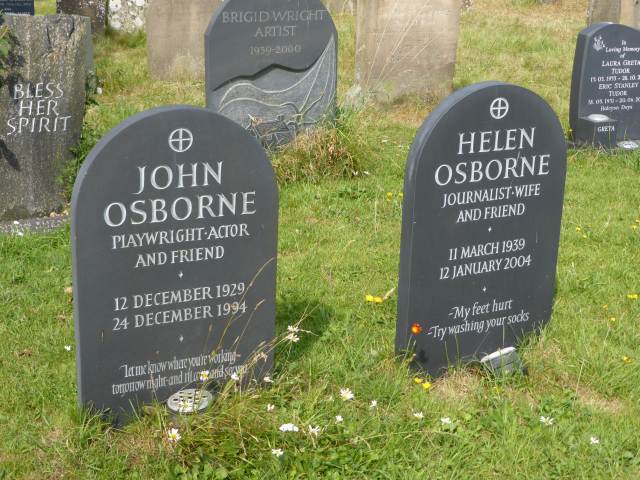
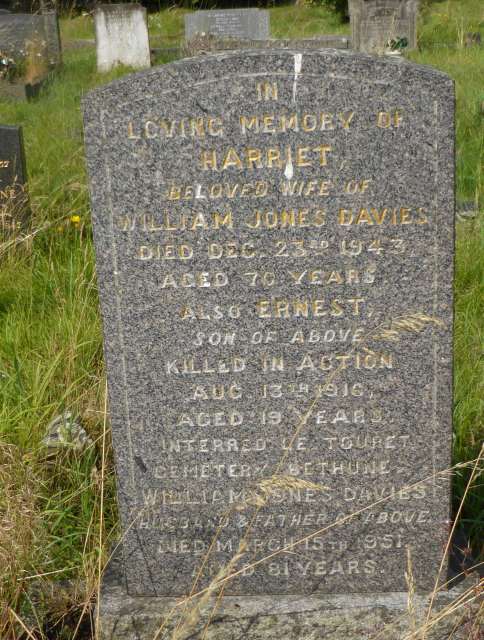
One of the 'attractions' of the area is the grave of John Osborne.  As we got into Clun I saw the cenetery so pulled in find said grave.  It didn't seem to be there but stone told a sorry story.
We then spotted St Georges Church - a dominating presence above the village - and it also had graves in the churchyard including that which we sought, together with that of his wife.  Wikipedia reveals that they actually lived in Clunton rather than Clun..
The church.
The "Caring for God's Acre" approach recognises the importance of churchyards as refuges for wildlife at a smaller scale.  As I have said elsewhere there are a few cemetery trusts in Australia that couldbenfit from this approach.
The artwork here was created by an Abyssinian artist to memorialise the death of Dermot Thesiger the third son of W Thesiger of Milebrook House.  On researching this

  • checking with "A Life of my choice" by Wilfred Thesiger; and 
  • the website for Milebrook House (thank you information lady at Knighton for that information)

I found that Dermot was the younger brother of Wilfred Thesiger whose exploits as an explorer and soldier in the 20th Century have fascinated me for years.
An interior shot of the church.  Again the kneelers are a great splash of folksy colour.
On our way to Rhayader Frances was able to catch this guy managing the verges.  In the really narrow lanes I think they cock the cutter up to prune the hedges.
A couple of shots of the central area of Knighton (or Tref-y-Clwdd).

We wanted to see a bit of Offa's Dyke which formed the border between Wales and England.  This was a small section close to the visitors centre.
The whole dyke is many kilometers long and is one of the long walks of the UK.  We didn't have time to do much walking but were quite amused by these sign posts.

Heading on towards Rhayader we found another tract of open grazing with sheep wandering around (or in some cases sitting in the middle of the road, not moving for cars).
We got to the farm somewhat early, having made good time from Knighton, and the person selling tickets said we didn't need to be in the hides until 2:45, rather than the 2pm we had read somewhere.  So we went to do their Farm Trail.  This gave a good look at the hides from outside.
Somewhat higher up it gave a good look down at Rhayader and across to the hills behind in mind.
The way was well marked.
At 3pm the feeder turned up and started to wield a shovel.
Click on this to get an impression of the flock of kites swirling around as they decide when to come in to feed,  Other pictures of the Kites, and other birds involved are in a separate page.
This was a fantastic facility developed by the owners of the farm.  They are to be congratulated on what they have achieved.

We drove straight back home to finish packing.  My beer tonight was one I picked up in Shrewsbury the previous day.  It celebrates that town as Charles Darwins birthplace.

Bird of the Day:  Not hard.  Red Kite
Building of the day: St Georges Church, Clun.
Garden of the Day: no nominations
Bad taste of the Day: the Catholic priest and his friend who rabbitted on loudly about church local politics most of the time they were in the hide at Gilgrin.
View of the Day: Looking down from the high point at Gilgrin