Showing posts with label national trust. Show all posts

Sunday, July 7, 2013

July 21 The 2 Arthurs- King and Uncle

Uppark House, Petersfield, East Tisted, Hinton Ampher, Winchester

There are rumours, apparently commenced by Malory (the author of  Le Morte d'Arthur not Mallory the former mountaineer - although the latter did go to Winchester School) that Winchester, our main objective on this day was the site of Camelot.  Consensus seems to be it was a totally fictional joint invented by folk telling a good yarn!  That is the King Arthur.

My Uncle Arthur was - in the 1950s and 60s - a blacksmith in East Tisted, which village I hope to visit today.

I woke early and by 5:30 was out on the seawall running East into a nippy wind.  The dog walking classes were not yet evident but a couple on interesting signs were read:
  • Mulberry Harbour – a key part of D Day was built off Selsey and then floated across to Normandy;
  • At the end of the track a sign announced that the view from that point across to Bognor inspired Eric Coates to pen a tune by the name of Sleepy Lagoon, used as the theme song for Desert Island Discs on the BBC.  (I am advised that cultural references are needed to appreciate the significance of this.)

Round about the time I got to the second of these signs I became very interested in finding a third sign announcing the presence of a khazi.  Unfortunately, when I did track one down, it also announced that it was locked overnight.  But wait! there's more: the ones about 1km down the track are opened 24/7.  Sorry, wrong: that facility was also locked.  Fortunately for the environment of West Sussex -possibly also East Sussex, most of Hampshire and the Isle of Wight -  this was only 200m from home and I made it.

Frances and I then went for a walk along the main road to the shingle to go further West.  This soon ran into private property so we wandered back through a residential area.  The houses were large 

and the cars all new (and needless to say mainly imported).  Selsey is not an impoverished area, but it did cause us to wonder what the folk did for a living: it is about 8 miles from the nearest large town and railway station and there doesn't seem to be any manufacturing here.

After breakfast (accompanied by a perusal of a copy of the Sunday Independent, acquired for £2.20 and worth about 15p) we headed off in the general direction of Winchester.  We had to pass through the edge of Chichester to do this and found a triathlon going on.  In fact the triathlon bike leg pretty much followed our route.  This made the driving rather dangerous as many of the competitors appeared to have little idea of road safety, and the roads were – this being England – narrow and twisty.  We didn't hit anyone but we wondered what the death toll was overall.  There was massive support effort with marshals at every intersection.  On the one long downhill there were lots of signs about danger and a marshal on every bend!
 We eventually ended up at Uppark House and Garden.  We got there before they opened at 11 and it was explained to us that the house didn't open until 12:30 but we could take a mini-tour starting at 11:10 where we could see a few rooms.  This seemed like the best of an average situation so we did as suggested.    While waiting for 11:10 to arrive we took the opportunity to look closely at one of the flint-studded walls common in the area.
This made it obvious that this was a traditional equivalent to brick veneer with the flints simply filling in the gaps between the timber frame members, and having no load bearing function.

The mini-tour was brilliant.  The guide was very knowledgeable and had a very good grasp of the story.  A main part of the recent history of the House was a huge fire in 1989 which effectively gutted the place.  (It seems this was started by contractors, but I'm not sure how.)  Anyway the firies were there within 15 minutes of the alarm being raised and decided quickly that the upper floor was a goner so ignored that and worked towards getting all the art and antiques out of the ground floor.  They did this very well indeed, apart from not knowing how to remove a few things:
  •  the grand piano was covered by a carpet and lost (the carpet had a corner burnt off, which was repaired in Hungary, as no-one in England can hand knot carpet any more!); and
  •  a large 4-poster bed was only removed – by NT - staff the next day and 15 minutes later the ceiling in that room came down.
The insurance on the property came up with £20m and the contractors were sued for another £1m so the NT didn't have to cough up anything.

The other story was the ownership of the house.  At a relatively recent point the then owner, aged in his 70s married his dairymaid and they lived there happily with the dairymaid getting very involved in running the place.  Eventually the old chap died and the estate passed to the dairymaid.  She invited her sister to join her and when the dairymaid died the house passed to the sister (the dairymaid not having fallen pregnant).  I think that they decided that when the sister died the house would pass to the son of a friend.  His descendants still live in houses on the estate and the restored upper floor of the House.


We then wandered around the gardens after watching a Red Kite patrolling the valley below.  I reported this to someone and they said that the birds are now regular.  There will be more about Red Kites in another post, but when I left the UK in 1970 they were still on the verge of extinction in the UK with a few pairs in Wales.  Now it seems they are are regularly observed over a fair part of England and wales.

We headed off towards Winchester.  A diversion occurred to visit the village of East Tisted where my uncle used to own (and operate) a smithy.  (As a total sidetrack, as I type this I was thinking about my visits there as a child and can suddenly smell the red hot shoes going on to the horses hooves.  Anyone who has attended such an event will know to what I refer, and that this is nothing to do with breakfast toast being created.)  The house it still called The Forge but the smithy – and the income supplementing petrol pumps – are no more (but the stable where my cousin kept her horse is still at the back).
We have just (2/2/2014) come across this old postcard of East Tisted which my Aunt sent me in July 1953.
The relatives house is the one at the RH end.

We went for a squiz at the excellently preserved church with good memorial plaques and admired some of the other houses in the village.
On, on towards Winchester with a swerve into Hinton Amper (and a few curses at the yokels with two tractors dragging hay along the road from East Tisted) .  The big deal here was the excellent garden.  

The ownership of the house was again interesting ending with a gent described as “a committed bachelor” - can the truth be a euphemism?- leaving the property to the NT.  
An interesting sidelight was a displayed letter, signed Elizabeth R, thanking the owner for his hospitality and an accompanying note from a member of the Royal Household saying that the handwriting of the letter was that of the Queen Mum but they had no record of the visit.  A guide explained that the interpretation of this was a comfort stop: public conveniences are not on the cards nor are convenient bushes (the problems being more than stinging nettles).

The NT shop here was selling local bottled produce which will be commented on later.  They also got some action from Frances who acquired a book about NT houses and another blanket.  A final comment is to note that a Classic Citroen Club was visiting the place with a lot of Maigret specials parked out the front of the house and attracting a lot of looks from the other visitors.

Leaving there we headed to Winchester and despite the efforts of the people who leave crucial information off signs made it into the city centre.  However there was no indication of where the Cathedral was so we didn't want to park and find we had to walk 2 miles.  I asked someone who looked like (and probably was) a local but they were in training for that oversubscribed occupation of village idiot and didn't know.  Interestingly that is the second time we have asked people for directions to physically massive and economically key sites and the locals haven't known.  After a very confusing lap of the city centre we arrived back where we started but having spotted the cathedral so knew to park there.  The car park was a tribute to incompetence (I'm not sure if it was the Council or the private sector):
  •  despite all the signs about pay and display it turned out to be free on Sundays!
  • the lifts didn't work (and hadn't done since about June 2012);
  • we had gone up 2 levels but were on level 4 and then went down 1 level to the street.

 We got to the Cathedral and found Evensong about to kick off so wandered in to join the throng (thus not having to pay, and getting some music thrown in).  Frances really enjoyed the music but it wasn't to my taste: apparently it was quite modern and thus showed off the cleverness of the composer and singers.    I was intrigued by one of the Lessons which went on about defending the city from “ruthless aliens” - Anglicanism defined by the BNP? - and the modern language used which lost all the feel of the old prayers which I remembered (but were probably not understood by the MP3 generation).

Once the Service was over I was free to take photographs 
including some of the memorials around the building.  This extensive list is of members of the Royal Hampshire Regiment who have died on service.
This is a memorial to Sir John Campbell who died at Sebastopol in fighting during the Crimean War - not a conflict memorialised in Australia.
There were a lot of other military ones (including the men of the Pay Corps – I have never found one to the dunny builders of the Pioneer Corps) and a very large brass on the wall and flagstone in the floor for Jane Austen.  (She was about to get a lot of air-time as a result of being put on the 10 pound note!
 On home.   This was basically a blat for about an hour, interrupted by refueling on the outskirts of Chichester and finding we had averaged about 38mpg which is not too bad.  (From a comparison with later results this suggests the car wasn't exactly brim full when we picked it up, but also indicates the way travellng at motorway speed increases the fuel consumption.)

Evening libations for me were Arundel Sussex Gold Ale (very hoppy and refreshing) and, while waiting for our take-away fish and chips to be cooked at the Lifeboat pub, a slightly softer styled pint of St Austel Pride bitter.  The latter comes from Cornwall so wasn't really local but close enough when thirsty.  Frances partook of Tillingdon Hills cider purchased at the Co-op: she rated it as good  with a distinctive slightly herbal taste.

Bird of the Day: Red Kite
Building of the day: Winchester Cathedral
Garden of the Day: Hinton Ampher
Bad taste of the Day: the car park in Winchester
View of the Day: from the bedroom in Uppark House.

July 28 Three March towns

Ludlow, Leominster and Hereford.  I had hoped to go to Brecon as well but due to the Black Mountains getting in the way that looked like too long a drive.  Looking  back, as will be evident from today's report that view was spot on the money.


The rain stopped sometime during the night and I had a good nights kip.  When I woke I decided to watch the BBC News and was just in time to cop the Sports news.  This started off with a track meet where Jessica Ennis (if you can remember who she is I suspect you're English) finished the race.  She got interviewed extensively, while Sally Pearson (if you can remember who she is I suspect you're Australian) who won, didn't even get shown crossing the line.  Usain Bolt (you don't have to be Jamaican to know who he is) running in a relay race got less coverage that Sir Bradley Wiggins did for finishing in the peleton in the first stage of the tour of Poland (run in Italy for goodness sake).

They then moved on to the weather.  Some places on the East Coast had scored 3” overnight, .  The forecast for the rest of the week sounded typical of an English Summer: sunny spells with scattered thundery showers.  (I've just realised this is my first reference to the weather, a remarkable outcome from spending a week in the UK.  This probably reflects it being beautiful weather all the time we were in Selsey.)

The basic plan today was to go down to Hereford about 25 miles (ie 40 km) South, check that out and comeback North calling in at Leominster, Berrington Hall and Ludlow en route.  That is pretty much what happened.  Again putting in a parenthesis, I will offer a few comments about the official view of driving in the UK:
  • there are many, many signs about speed cameras.  Possibly 25% of these seem to be associated with actual cameras, the rest are just propaganda.  However I take note of them and drop to the speed limit unlike other folk who scream past.  Today we went past a camera and the guy who had just overtaken me must have been doing at least 10mph over the limit, but he didn't even brake. 
  • That caused me to think of stats from our last visit that >50% of speeding fines, license withdrawals are ignored.
  • There are a lot of other signs exhorting one to slow down (for an intersection, a crest, a case of indigestion).  Obviously they have never read the story of the boy who called wolf!
  • At one point today I was doing 50, overtaking someone doing 35 in an unlimited area, when a sign flashed “Slow Down”at me as they had an advisory (I think) 40 limit for an upcoming bend.  Distracting garbage!

 We started by looking at the old church in Tugford.
A simple building but with some charms.  I noted that they had deliberately only mowed half the graveyard allowing the remainder to be 'natural'.  A few cemetery trusts in Australia could learn from this. The main war memorials are in that thematic page, but this manuscript appealed . 
So did these old fertility symbols: only 2 others known in Shropshire!
We basically hammered down the road to Hereford, and into the free TESCO parking lot, to get to the cathedral before the 11am Matins.   This was obviously a well known ploy as they had started business with a Eucharist at 10am.  The singing was quite good so at 10:15 we sat in the pew until we realised at about 10:30, on page 3 of 9 in the Order of Service, that this was going to be a long service so wandered off.  Like many towns in the area Hereford was well served with planter boxes.
We started with the museum where a roman pavement was mounted on the wall

and spoke to some folk who gave us a small, but very useful, map and told us how to get to the River Wye and pointed out that en route we'd pass the site of Nell Gwynn's house.  The plaque their made no reference to her involvement in the citrus trade, nor who sired the first Duke of St Albans. 
We crossed the River Wye and reconnected with Edward Elgar due to an episode - in some way incorporated in the Enigma Variations - with a friend's bulldog jumping in the River. 
Some Mute swans were sunning themselves on the banks of the Wye,
Back to the Cathedral and quickly in between the Eucharist finishing at about 11:15 and Matins kicking off at 11:30.  An excellent cathedral – not quite up to Worcester standards but with much good glass

The second image is of the "Thomas Denny Windows".  The artist responsible for this appears to have started his career in glass more or less by accident in 1983 and now has windows in 30+ churches across the UK.   There were also many interesting memorials sampled in the appropriate post.

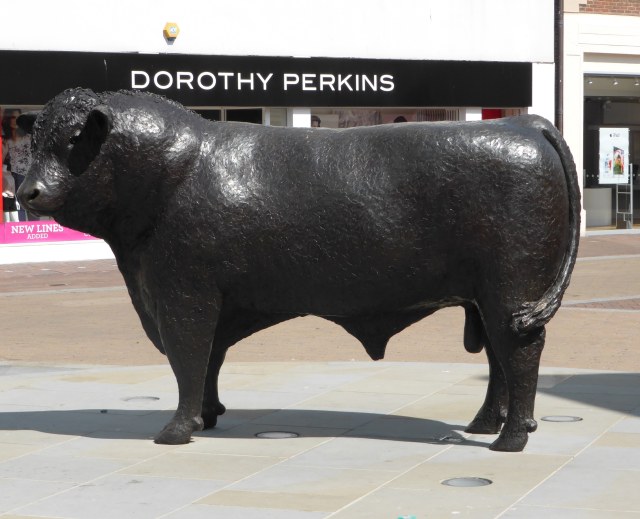
After this we wandered around Hereford finding several interesting items.  I have restricted my burden on your download limit to this, reflecting the origin of my favourite breed of beef in this County.
Back to Leominster where there seemed to be two specially interesting buildings according to the guidebook.  In fact it was a bit better than that with a good mural 
titled "The Friendship Tree" painted by Sally Johnson and Mike Johnson..   The Priory Church was interesting for having a Norman/Romanesque old bit and a later addition heading towards a Perpendicular/Gothic feel.  A service was just finishing but a nice lady still welcomed us (while her male colleague turned off all the lights)!  Here is an image.
The other officially interesting building was the Guildhall.  The image would reflect the level of  interest better if the gardener's truck wasn't in the way (but they were working on a Sunday so lets not be too hard on them).
Then to the NT's Berrington Hall. 
A very interesting building with park grounds in which Capability Brown had been involved: towards the end of our visit I inspected the haha  (which by definition is invisible from the house but is indicated by the faint line on this side of the foreground tuft of grass).
Looking at the depth of this effort I decided that the Pratchett character “Bloody Stupid Johnstone” (whose hahas killed many people by excessive depth) was not a great deal away from the reality of the better known Mr Brown. 

On the next stretch of the drive I noticed my first dead badger of the trip.  I presume it was a road fatality not part of the cull being taken to reduce a claimed TB situation.  On the last trip the roads around Bristol had basically been surfaced with dead badgers but they have been less evident this trip (so far).  

Ludlow then got looked at and rated as a very nice town.  

The Church of St Lawrence was mind-boggling, especially when 'only' a Parish Church.  I have no objection to the view of the church architecture person who described it as the Cathedral of the Marches.


There were many very interesting war memorials in this church and they are all ....  I will also show this sample of the workings of a carillion (of interest to me because I had never realised how they worked in the past).


Then, tired but happy, we wandered home, attempting to buy some stuff from the Ludlow Brewery but no-one was interested in serving me.

Tonight's beer was BV Stout from Mayfields Brewery in Herefordshire.  A good stout even if named after Black Vaughn who seems to have been a very naughty boy in 1469 (and later, when his ghost wreaked havoc).  It did a good job of settling my digestion down before asking it to deal with an excellent pork pie, courtesy of – wait for it – Tescoes.

Bird of the Day: Nuthatch seen at Tugford
Building of the day: St Lawrence Church in Ludlow but Hereford Cathedral had put in a big effort in the final quarter and only missed out narrowly.
Garden of the Day:  Walled garden at Berrington Hall
Bad taste of the Day:  poor service at the Ludlow Brewery

View of the Day:  The parkland at Berrigton.

Back to the Index page

July 30 The Bard and The Borders

Stratford on Avon,  Hidcote Manor.  

I was a wake at 5am and it was well daylight so I decided to go for a waddle round the lanes.  When driving I hadn't realised how hilly they were!  It was a very pleasant start to the day especially at the top of the hill out of Bouldon where there was a great view (if one is into irregularly shaped paddocks with grain at various stages of ripeness giving a very variable palette.  (I was also going to fit the word 'texture' in there somewhere, but my gag reflex cut in.)

We left quite promptly on a trip aimed to get to Hidgrove garden.  This is a fair way from Tugford and we had wondered about calling in there on our way from Brum to Selsey.  I had felt that it was better to come back since we wouldn't be able to spend much time at the garden in the middle of a long drive.  Although I realised it was still going to be a longish day in the saddle doing it this way at least we weren't faced with setting up a place at the end.

It was also a chance to check out most of the route back to Birmingham Airport and it didn't seem too bad.  (Subsequently checking out Google Maps suggests this wasn't as good a route as I had thought.  We shall decide later!)  The major problem on the way out was a tractor dragging a trailer load of wheat up a very steep hill: it was so underpowered it was down to 5mph – and belching black smoke – at one point.  We had to follow it for about 2 miles which seemed to take for ever. 

On the other hand we found Clee Hill which gave stunning views over a huge area.  There were a number of signs saying “Don't feed the sheep”.  The woolies were evident in fair numbers grazing beside the road, but I felt no need to stop and vary their diet.  On the way back we did stop for a photograph.

Kidderminster was transited with no problems as was Bromsgrove.  Our intermediate target was Startford on Avon, mainly because I'd never been there and it is a big ticket tourist item.  This is of course to do with William Shakespeare and as we approach the town saw a sign to Ann Hathaway's Cottage so followed the signs into the parking lot for that edifice.   We parked – at £1 for 3 hours it was good value – and walked up the road to the cottage itself.  We swiftly decided that at £9 a head this was not good value and walked back towards the car, taking a couple of snaps of the place as we went. 

It was pleasant looking, just not £18 worth!

Knowing as we do that most places in the UK are very short of parking (and charge like wounded bulls for the privilege) we left the car where it was a walked the mile into the centre along a signed footpath, getting a good look at non-Shakespearean Stratford as we did.  The most intriguing bit of this was an intersection with another path where the alternate route was blocked off by police tape, with Mr Plod X 4 standing just a little bit down the path.  No idea what was going on, but the other punters on our path were all muttering about it: obviously no-one was game to ask Mr Plod for fear of spending some time assisting them with their enquiries or having to buy tickets to the Policeman's Ball.  (For similar reasons I decided taking a snap was Not a Good Idea.)

The town centre was quite attractive with a bunch of old buildings with a couple announcing tenuous connections to the Bard.  
Passing by the Garden of Rememberance – noting the soldiers prayer
- we carried on to Trinity Church and Shakespeare's grave.  The grave is actually in the church and to really look at it one had to throw £2 to a guy handing out leaflets.  Or, if you were taller than the coachload of ragazzi (Italian schoolkids) in the area, you could take a distant photo. 
The church was very good to look at and seemed to be reasonably similar to a 17th century painting (except for the added organ).  The organ was being played very well, but the organist didn't take requests.  Some interesting War Memorials were snapped and are included in the relevant post.

We strolled back to the car noting that Mr Plod was still evident, although only 2 rather than 4.  As they might still have a few tickets to issue or sell I still didn't pursue my interest in their activities.   We fired up the car and headed off towards Hidcote which seemed to involve going though the centre of Stratford.  It appeared that the main street had a function of car park rather than thoroughfare but it gave us a good look at some parts we hasn't been to.  We ended getting a double look at one area as the people responsible for traffic signs had stuffed up a crucial one, burying the phrase “All other routes” in the middle of directions to car parks.  Whatever: we found our way out.  As we drove down the road I marveled yet again at the ability of British 'drivers' to go down a small road at trivial velocity and then, once overtaken, turn off.  They get a walk down the red carpet in the awards section of this post.

With a little fiddling around we got to Hidcote Garden.  The car park was pretty full with volunteers directing visitors.  As a guide I spoke to later reckoned the place was 'very quiet' we wondered where people parked when it got busy.  We had a look round part of the garden before attending a talk about the history of the garden.  Here are a few of my images.

This cedar is one of Johnstone's originals in the 'room' (yecch: for some reason I hate that word in this context) now called the Old Garden.

A first border!
The developer was Lawrence Johnstone and rather than B S Johnstone (referred to earlier) I would rate him as Bloody Clever Johnstone.  His mother was a wealthy American who had bought him this place to indulge his interest in gardening.  It is possible she hoped it might also interest him in starting a family.  (She also gave him some procreational encouragement with her will, in which he was to get to income from her estate – about $900,000 per year – but he only got the (very serious) principal if he had an heir.)  Alas, he seems to not have been interested in the basic strategy for breeding humans, and on his death a bunch of US based nephews and nieces got lucky.

It really was an excellent garden.  Quite possibly the best we have ever seen anywhere.  Since Johnstone was in financial difficulty by the time of his death he had clearly been putting a lot of the $900k into the place every year.  He left the garden to the NT (who took some persuading to accept it as at that time, but not now, they only took houses, some of which had gardens).

The vegetable garden had particular interest as it was surrounded by a solar powered electric fence. We wondered what was being kept out, and it turned out to be rabbits (in the past) and badgers.  

The rabbits are no longer an issue as myxomatosis wiped them out two years ago and they haven't repopulated.  Also of interest was a photograph of some pigs which had been used to stir the soil up and fertilise it.  They had been kept on the area for too long and rather than loosening the soil had compacted it.

A few more pictures of aspects of the garden.  There were many forms of dipterid (flies to you) around the garden.  Here is one.
We were pretty certain this is a form of Eryngium, another species of which, E. ovinum, grows in our paddocks, being known as Blue Devil.
I thought this Delphinium got my prize for stunning flower head of the day.
 It is not often that one is able to get a snap showing a bumble bee coexisting with a European wasp.
On a personal note the guide who spoke mention that Johnstone had corresponded and exchanges plants, with many other plant collectors.  I asked if that had included E A 'Gussie' Bowles for whom my Dad had worked in the 1930s.  It turned out that he had particularly with the rockery plants .
I spoke with several of the workers and guides around the gardens and the were all both charming and knowledgeable.  We concluded that we had definitely made the correct decision in not coming here on our way to Selsey.  We spent somewhat over 3 hours in the place which would not have happened under the alternate strategy.

After getting home including a stop on Clee Hill to check the view ...
...  we went for tea at the Tally-Ho pub in Bouldon.
A really nice pub which was doing good trade.  I had an excellent steak and kidney pie
while Frances had fish and chips, which she rated as OK (because the fish component was good on batter but a trifle thin in the matter of cod).  Beers consumed were:
                     Ludlow Gold - a bit fuller bodied than many of the beers I have tried on this trip but definitely potable) and
                     Woods Wonderful – somewhat stronger than many I have tried at 4.8% but an excellent sample.
As might be expected the décor was somewhat hunting oriented.

Bird of the Day:  Pelican: refer discussion of British drivers around Stratford.
Building of the day: Ann Hathaway's cottage
Garden of the Day: Hidcote, Hidcote, Hidcote
Bad taste of the Day: The plastic lion outside a safari park at Kidderminster.
View of the Day: from Clee Hill.