Showing posts with label RSPB. Show all posts

Sunday, July 7, 2013

July 23 Old fogeys of the New Forest

Thorney Island, Lyndhurst, Beaulieu

Those of advanced years might note in the title a backhanded reference to the book "Children of the New Forest" which was very popular in my childhood despite being published in 1847.  I had thought this was due to Churchill and McMillan's interest in restoring a quasi-feudal society in the UK.  Rather than denying this theory, noting that the BBC last televised it in 1998 makes me reassess Tony Blair's intentions.

It appears that Ms Cambridge provided a third generation of succession about 4:30pm yesterday.  Sky News was full of it (idiomatically, Sky News is usually "full of it" but this was specific not a scatological geeralisation).  It would have been fun to see how conflicted they'd have become if the event had coincided with the finish of Le Tour!  The masses – OK a bit of a crowd – were gathered out the front of Buck House, presumably to read the notice because there was nothing else to see.  I have just watched a guy from a ceramics company talking about all the sales they are expecting.  Apparently it will take them 4 days to get all the stuff made and distributed with the name etc.  So we may be able to find the Engraved Gazunder before we leave

This morning I went for a run around the whole of Selsey.  (In a cryptic crossword, the word 'whole' would be preceded by “sounds like”.)  After getting up to the main street I took off to look at the holiday park area.  There are at least 4 Parks and the one I ran through (West Beach) seemed from a map to have some 1,000 chalets.  This makes sense of the information sign suggesting that the population of Selsey at 12,000 in Winter doubles in Summer.  While it is very much the sort of place we avoid like botulism (although I didn't find the mini-golf I am sure it was in there somewhere) there was at least a reasonable amount of turf between them, unlike the Butlins Camps of the 1950s and 60s which were modeled on 1940s camps (in Eastern Europe).

When having a whinge one should never reject targets because they are too easy.  Yes, I am going to give British Telecom a serve.  I looked up the phone book to find the overseas access code when calling from the UK.  I am told to check on line – great if I had internet access in this country (at less than the £4 a day which BT charge).  Then I could buy – like spoilt kids in Africa, telcos are always crying “Give us money” - a book!  Or I could ring them – at premium call rates to find out.  I took a guess at 0011.

The weather looked reasonable so we decided to:

  1. go to the New Forest for a look round; and
  2. do a load of washing.  

In fact we did 2 before 1 and while waiting for the machine to finish its stuff went and sat above the shingle.  We observed the meeting of the mass of dog owners 
which was most amusing: the owner of the fox terrier was heard to say that the way his dog pounces on its ball indoors has worn out the carpet.  Just imagine such behaviour from a small terrier.

Moving East to see if there were any interesting birds around we spotted this small trawler coming in.  
It would appear the fisherperson had been chucking guts etc overboard.  When he landed he had two largish boxes of skate bits, which I reckoned to be worth about £100.  Not a great return if he been far out or for very long.

Heading off we zipped along the A/M 27 and M271 and first stopped in Lyndhurst.  This is described as a pretty village in the Forest.  Which it is.  The only problem with this is that two A class roads meet there and as a result it is clogged with traffic.  
What it will be like in a couple of weeks when the holidaying hordes really kick in is beyond belief – and possibly beyond imagination.  From our view the best thing was grabbing some brochures about the area (noting how astonishing it was to have to pay for parking at the Information Centre) which suggested – as well as a lot of retail opportunities - a visit to the Church of St Michael and All Saints.

This pub sign on the way to the Church was the most amusing I noticed while in the UK:
There were two excellent + things about this church:

  • Much of the design and glass were by prominent pre-Raphaelites (and I m sure you remember them from Brum);


  • An Alice Hargreaves (nee Liddell) is buried there.  She was the catalyst for Alice in “Through the Looking Glass” and “Alice in Wonderland”.
As well as her grave – a simple monument made very picturesque by the rose bushes –
 I had already taken a photograph of this memorial plaque
not realising the guys commemorated were her sons.  She seems to have been a very active and respected member of the local community.

We then headed off towards Beaulieu to a birding spot recommended in my birding guide.  We were barely out of town before finding our first New Forest ponies.  
On my childhood visits, accompanied by an equiholic cousin, I seem to remember having great trouble finding any ponies.  Today they were everywhere, including the place we stopped to go for a walk: as they seemed to be looking longingly at our baguette we didn't get out until we had finished eating.  It was a lovely walk adding a few species of bird (including Stonechat) to the trip list and getting good snaps of a few of the flowers in the heath.
The forest was also very appealing.
 Here we have a carollic image including both holly and ivy!  Possibly they can be regarded as both well grown.
We then rumbled off to Beaulieu where handing over gelt seemed to be required to do anything. We didn't wish to go to the Motor Museum (a working racetrack, or display by a bunch of enthusiasts is one thing but handing out our hard-earned to look at a static collection is very different).  So we moved on, stopping briefly at a small church in Exbury which had a couple of interesting memorials.  We had never heard of this GG of Australia!
The kneelers were also interesting as the first example of this form of community art seen on this trip.

These ponies seemed undisturbed by the distant industry (nor by the dog being exercised in the background).   
I commented on our last trip that the definition of a National Park in the UK is very different to Australia: whole towns are within the Park as are farms and  recreational activities.  (I'd love to see the Head Canophobe from the NSW National Sparks and Wildfires Service react to a dog running around near iconic wildlife!  A defibrillator would be needed.)  Our final pause was a beach at Lepe where we took a hazy image – the camera doesn't lie – of the Isle of Wight.
We then headed off through some very, very confusing signs which I got wrong a couple of times, to the M27.  Our final destination for the day was a site marked as RSPB on our road atlas but try as we might we couldn't find the place.

So we went home for a cleansing Ale or, in Frances case, cider.  My ale was the third sample from Arundel the dark and stronger (5.5%) Old Knuckler: this was a very chewy and complex dark ale indeed.  Well done that brewer!  After this we toddled off to the Seal Pub (in the Good Beer Guide) for tea.

I was initially put off by being asked if we had a reservation, but then things settled down and we had an excellent locally caught crab salad, washed down with a pint of Hophead beer (from Brighton, so nearly local).  It was quite obvious why it is called HOPhead!

Bird of the Day:  Stonechat
Building of the day: Church of St Michael and All Saints
Garden of the Day:  Alice in Wonderland's grave
Bad taste of the Day: The traffic in Lyndhurst
View of the Day: Most parts of the New Forest

Back to the Index page

August 1 Closing off the trip

Shrewsbury, Much Wenlock, Ironbridge.  Sorry, that was yesterday.  Today is Clun, Offas Dyke and the red Kite feeding station.

The weather today seemed to have got its act into gear, so our plan was to visit Clun, and end up at the RSPB endorsed red Kite feeding centre at Gilgrin Farm, Rhayader in Central Wales.  The day was planned so that we got to Gilgrin about 2pm: they feed the kites at 3pm and the guidebook suggested getting there an hour earlier to ensure a good spot.

We hadn't heard of Clun until we came across a leaflet in the array of material available in Trap Cottage. There seemed to be a couple of Nature Reserves in the area and the church seemed interesting.

Before setting off we wandered up the road beside the farmyard and found some interesting stuff.  This view goes over to Brown Clee Hill.
The farmers seem to have their own version of Neighbourhood Watch.
Churches, most of which had signs up about everything being marked, seemed to have a similar scheme operating.  I'm not sure if that is why so many Anglican churches were open for visitation.  It was notable that few Catholic or Non-conformist places were open.  Perhaps they can't afford this security scheme?

Sheep trying to raise the browse line!
I hope this is the Tugford Ash.  Quoting from the Farm website ".. the largest Ancient Ash Tree in Shropshire, with its girth of 6.8m it is also one of the ten largest in The British Isles."  It is a registered significant tree.
We drove past the Diddlebury Church many times and finally got to stop there this morning.  A very pleasant small village/parish church.
As we headed off towards Clun we found this pub in Aston on Clun.  I have no idea why a pub in this area should call itself the Kangaroo!
Before getting to the main village we went to look at Clunton Coppice quite high above the village of Clunton a couple of miles East of Clun itself.  Judging by the moss growing on the trunks of these sessile oaks it get quite a bit of moisture.
A view from the coppice out over the valley.
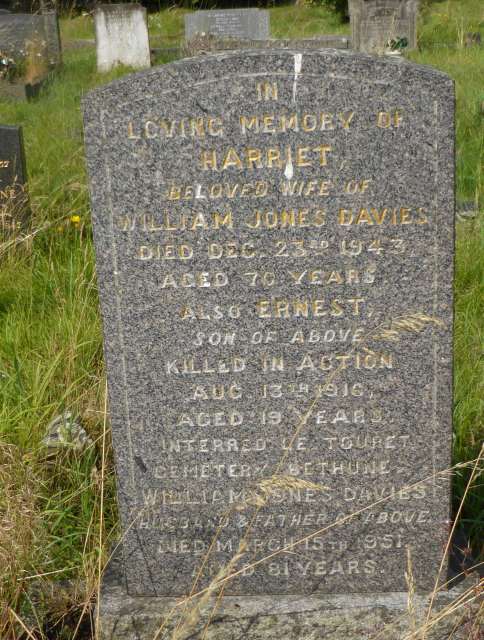
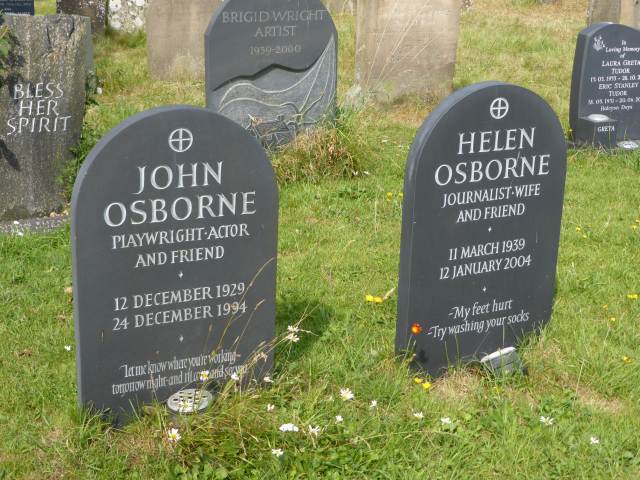
One of the 'attractions' of the area is the grave of John Osborne.  As we got into Clun I saw the cenetery so pulled in find said grave.  It didn't seem to be there but stone told a sorry story.
We then spotted St Georges Church - a dominating presence above the village - and it also had graves in the churchyard including that which we sought, together with that of his wife.  Wikipedia reveals that they actually lived in Clunton rather than Clun..
The church.
The "Caring for God's Acre" approach recognises the importance of churchyards as refuges for wildlife at a smaller scale.  As I have said elsewhere there are a few cemetery trusts in Australia that couldbenfit from this approach.
The artwork here was created by an Abyssinian artist to memorialise the death of Dermot Thesiger the third son of W Thesiger of Milebrook House.  On researching this

  • checking with "A Life of my choice" by Wilfred Thesiger; and 
  • the website for Milebrook House (thank you information lady at Knighton for that information)

I found that Dermot was the younger brother of Wilfred Thesiger whose exploits as an explorer and soldier in the 20th Century have fascinated me for years.
An interior shot of the church.  Again the kneelers are a great splash of folksy colour.
On our way to Rhayader Frances was able to catch this guy managing the verges.  In the really narrow lanes I think they cock the cutter up to prune the hedges.
A couple of shots of the central area of Knighton (or Tref-y-Clwdd).

We wanted to see a bit of Offa's Dyke which formed the border between Wales and England.  This was a small section close to the visitors centre.
The whole dyke is many kilometers long and is one of the long walks of the UK.  We didn't have time to do much walking but were quite amused by these sign posts.

Heading on towards Rhayader we found another tract of open grazing with sheep wandering around (or in some cases sitting in the middle of the road, not moving for cars).
We got to the farm somewhat early, having made good time from Knighton, and the person selling tickets said we didn't need to be in the hides until 2:45, rather than the 2pm we had read somewhere.  So we went to do their Farm Trail.  This gave a good look at the hides from outside.
Somewhat higher up it gave a good look down at Rhayader and across to the hills behind in mind.
The way was well marked.
At 3pm the feeder turned up and started to wield a shovel.
Click on this to get an impression of the flock of kites swirling around as they decide when to come in to feed,  Other pictures of the Kites, and other birds involved are in a separate page.
This was a fantastic facility developed by the owners of the farm.  They are to be congratulated on what they have achieved.

We drove straight back home to finish packing.  My beer tonight was one I picked up in Shrewsbury the previous day.  It celebrates that town as Charles Darwins birthplace.

Bird of the Day:  Not hard.  Red Kite
Building of the day: St Georges Church, Clun.
Garden of the Day: no nominations
Bad taste of the Day: the Catholic priest and his friend who rabbitted on loudly about church local politics most of the time they were in the hide at Gilgrin.
View of the Day: Looking down from the high point at Gilgrin


Saturday, March 27, 2010

Background to Birding

I have had a number of Field Guides to European Birds for many years.  Unfortunately I feel obligated to minimise the amount of stuff to schlep for this trip so I am planning to use "The Hamlyn Guide to Birds in Britain and Europe" Brunn et al .  This is primarily because it was printed in 1989 (after a revised text in Swedish in 1986) whereas my other favourite "The Birds of Britain and Europe" Heinzel et al dates from 1974!

So I should be able to identify the birds subject to the limits of my competence.  Where are the little blighters?  I am hoping that joining the RSPB will assist me to find them (as well as saving a number of $ on entry fees and car parking.  My basic planning source will be "Birdwatching in Britain A site by site guide"  Redman and Harrap.  Reference will also be made to "Wild Britain" by Douglas Botting.

Although this isn't going to be a twitching trip (apart from anything else I am too idle for that) I thought it would be good to sort out what birds I have previously seen in the UK and which I have not.  My first thought was that my Birdinfo software would have a good list for the UK: not so it was only 146 species rather than 530+ on the official list from the British Trust for Ornithology.   So I am creating my own using the BTO list as a base (fiddled with according to my memory of which birds I have seen in the UK).   It is interesting that even though the BTO shows 'International names' for some species they are not always the names I am familiar with.  For example they:
  • list 'Baltimore Oriole ' which has been  known in the US as the Northern Oriole for many years (unless talking about the baseball team);
  • translate the UK Great Northern Diver as the 'Great Northern Loon' while the usual name in North America - where they are far more common - is Common Loon.  (In this case the BTO appellation is somewhat egregiously wrong since the more Northern loon is the Arctic Loon.)
Oh well I guess I'll just stop kvetching and update my own list myself.

Friday, March 26, 2010

22 June: Durham and Salthome

Leeds is Kultur: Art Gallery and Fairburn Ings (birds) and the Yorkshire Sculpture Park!

The first day of the BIG 3: high success with buildings, birds and beer.

After an exercise walk around Ingleby Greenhow we headed off for Durham, principally to check out the cathedral. En route we stopped to buy our first fuel ( I keep wanting to call it petrol – fortunately I stuck diesel in the motor). Fuel consumption has worked out at 49.6 mpg, not bad with a mixture of motorway, urban and very rural roads.

A pretty simple drive into Durham, and by following our eyes got a park close to the cathedral. This was in a private park and was a tad cheaper than the council one in York. However, this place let you pay post hoc (so you didn't have to guess how long you'd be) and gave change so you didn't get ripped off. I don't see this as a public/private distinction, just that York Council employs some jobsworth prats.

Durham cathedral was magnificent. Possibly the best cathedral I have ever visited anywhere for magnificent architecture. Unfortunately photography was not allowed (presumably because it reduced guidebook sales). It was huge in every dimension and followed Norman designs: according to Francs' guidebook it was the first place to use pointed window arches which were subsequently used everywhere. We read that a service has been given every day for more than 900 years!

We thought the glass was better than Chartres (ie it actually was clean enough to let light through) and much better made than York (which was very cluttered with lead). However the space wasn't full of light but dim enough to feel impressive. By clicking my tongue I rated the acoustics as very good- I'd love to go to a full on choral service here.
The two most impressive memorials were:

  • the tomb of the Venerable Bede (about 900 years old); and

  • the miners Register which recorded the names of miners killed in accidents at each mine. 6 July 1951 was not a good day at one mine, to which the book was open as they lost 10 guys that day. Its a tough area.
On our way to the cathedral I had stopped to scope out some cormorants in the river and felt a dog brush against me. On looking round it was 3 fat skinheads in police uniform with a very scruffy and old looking pooch. We came across them later and they seemed to have some plain clothes colleagues emerging from the market with 'substances' which the dog was detecting. The dog also snuffled some citizens but didn't detect whatever they were carrying.
I met the first jobsworth, in the shape of a woman who said very officiously that the courtyard of the castle (now part of the Uni) was closed. I merely said “yes” in response, rather than “go tell someone who gives a damn”.
Our next stop was Salthome Reserve run by the RSPB. This was a stunning place where everything was well set up and managed but they had avoided turning it into a zoo. It was quite bizarre to find such a great place in the middle of a very heavily industrialised area. They had quite a lot of punters there – my guess was 60 cars at any one time in the car park (and June/July is the worst time of the year). I recorded about 28 species in the two hours we were there, with many of them breeding. 17 of these were additions to the trip list.

The two images show the visitors centre (with the cooling towers from a “power from waste" station in the background) and a flock of Grey lag Geese sailing off with a petrochemical plant as background. It says something about the importance of the place that signs started on the A19 about 5 miles (and 4 major intersections) away. Perhaps this is the sort of thing to which some folk aspire for Kelly's Swamp in Canberra. Other than the 'Field of Dreams' approach – if you build it they will come- the first job is to get reliable water in the place and the second is to staff and manage the place properly. I would say that Salthome would be a good model to follow., and the RSPB would be a good source of expert advice.
We then moved on a tad to the Teesmouth National Nature Reserve to see the nesting avocets. It astonishes me that when I was growing up there was huge excitement about a pair of these nesting at Minsmere in Suffolk, and now they are in a heavy industrial area several hundred miles North. We also saw 38 seals (a mixture of common and grey seals) hauled out on a mud bank a tad further away.
All of this had induced thirst so we repaired to the White Swan in Stokesley for refreshment. Frances had a cider while I inhaled two good brews from the Captain Cook brewery: Black Porter and Slipway Ale.

A few linguistic and cultural observations.
  • A Burger King in Durham was offering the chance to watch the World Cup final with Jimmy Greaves. I hadn't heard of him for many, many years but he is obviously still big news in the UK.
  • An advertising sign (for beer) in the heavy industrial area on the North of the Tees; “Same colour as a footballers wife. But better tasting.”
  • When in the pub we couldn't eavesdrop as we couldn't understand the locals talking between themselves. However when they talked to us they slowed down and the accent greatly reduced.

23 June: Yorkshire Sculpture Park

Durham.
That was yesterday and today was the day our plans from yesterday got implemented. As I found that the Yorkshire Sculpture Park (YSP) didn't open until 10am and we were awake etc and breakfasted by 6:30 I thought we could slightly vary our route and swing by Fairburn Ings (an RSPB reserve) on the way to YSP.

-->

This turned out to be a great idea as we saw lots of birds at the Ings (I think basically a set of revegetated waste heaps). Everyone we met there as frindly and I added 5 species to the trip list. (Another 2 were added at YSP, bringing the total for the trip to 68.) The best bird was a Whooper Swan, of which I had only seen 1 before (at Jamaica Bay in New York, where its 'tickability' was questionable at best). On checking with a local this one was quite sound.

After a brief thrash down the M1 past a power station – surely the inheritor of Blake's approbation of “dark Satanic mills” we got to YSP. What an absolute blast! I rate the place at least as good as Storm King in upstate New York. I will not add any images until I get back to Carwoola and can resize them, but I took 60 snaps today and they are mainly quite interesting. A special page will be created.

There was a special exhibition of the work of David Nash who does things with wood. The things done include
  • setting fire to it,
  • assaulting it with a chainsaw (and I suspect various other mechanical devices); and
  • letting it fall into a river and filming it over a number of years as it rolls downstream. (This one is weird as he lost it for a while and thought it had gone out to sea, but it re-emereged from a sand bar so the project is ongoing.)
  • Building a set of steps on commission by YSP 

Other highlights were
  • 3 Andy Goldsworthy walled things (the Hanging Trees were my favourite);
 
  • many Henry Moore's
  • Barbara Hepworth's Family of Man series; and
  • a set of Caros.
One issue about the place was finding out what works were: it was frequently a problem finding the labels which could be several metres from the work.

The works of Elizabeth Frink featuring male nudes were quite fun. It was livened up by the visit of a horde of schoolkids (of rather tender years and non-Caucasian backgrounds) who proceeded to touch 'sensitive' parts of  the art work in a fair number of inventive ways, which I will not go into here, to keep the porn police at bay.

There was quite a trek involved in viewing this place. I would guess we covered about 6kms (horizontal, and fair bit vertical) at a minimum. I was interested to see that here, like most everywhere else was well supplied with molehills. I suspect ths means that agricultural chemical use has been got somewhat under control. As a general comment it was very pleasing to find that dogs were largely welcome in most parts of YSP. as long as they were on a lead this included the areas with grazing cattle and sheep.

The distant view include a huge concrete tower/radio mast On asking a passing local this turned out to be Emley Moor Tower: the tallest free-standing stucture in Europe. It replaced an earlier steel version that had succumbed to cold and strong winds and crashed. I have put in a link to this in Wikipedia.

The beer report for today is not good. We went to the Dudley Arms in Ingleby Greenhow to find they sold commercial beers. I tried Calders 70 (an average mild) and Tetleys Midsummer madness which was flat warm and tasteless – a summary of what CAMRA set out to overcome.

As usual we could not understand much of the local conversations. One bit – by a young male person could be reproduced as “Hour mooch cud yer erve ud?” which we think translated to “How much could you have had?” Also on the linguistic line, Frances invented a new collective noun: 'an inadequacy of road signs'