Showing posts with label memories. Show all posts

Sunday, July 7, 2013

July 21 The 2 Arthurs- King and Uncle

Uppark House, Petersfield, East Tisted, Hinton Ampher, Winchester

There are rumours, apparently commenced by Malory (the author of  Le Morte d'Arthur not Mallory the former mountaineer - although the latter did go to Winchester School) that Winchester, our main objective on this day was the site of Camelot.  Consensus seems to be it was a totally fictional joint invented by folk telling a good yarn!  That is the King Arthur.

My Uncle Arthur was - in the 1950s and 60s - a blacksmith in East Tisted, which village I hope to visit today.

I woke early and by 5:30 was out on the seawall running East into a nippy wind.  The dog walking classes were not yet evident but a couple on interesting signs were read:
  • Mulberry Harbour – a key part of D Day was built off Selsey and then floated across to Normandy;
  • At the end of the track a sign announced that the view from that point across to Bognor inspired Eric Coates to pen a tune by the name of Sleepy Lagoon, used as the theme song for Desert Island Discs on the BBC.  (I am advised that cultural references are needed to appreciate the significance of this.)

Round about the time I got to the second of these signs I became very interested in finding a third sign announcing the presence of a khazi.  Unfortunately, when I did track one down, it also announced that it was locked overnight.  But wait! there's more: the ones about 1km down the track are opened 24/7.  Sorry, wrong: that facility was also locked.  Fortunately for the environment of West Sussex -possibly also East Sussex, most of Hampshire and the Isle of Wight -  this was only 200m from home and I made it.

Frances and I then went for a walk along the main road to the shingle to go further West.  This soon ran into private property so we wandered back through a residential area.  The houses were large 

and the cars all new (and needless to say mainly imported).  Selsey is not an impoverished area, but it did cause us to wonder what the folk did for a living: it is about 8 miles from the nearest large town and railway station and there doesn't seem to be any manufacturing here.

After breakfast (accompanied by a perusal of a copy of the Sunday Independent, acquired for £2.20 and worth about 15p) we headed off in the general direction of Winchester.  We had to pass through the edge of Chichester to do this and found a triathlon going on.  In fact the triathlon bike leg pretty much followed our route.  This made the driving rather dangerous as many of the competitors appeared to have little idea of road safety, and the roads were – this being England – narrow and twisty.  We didn't hit anyone but we wondered what the death toll was overall.  There was massive support effort with marshals at every intersection.  On the one long downhill there were lots of signs about danger and a marshal on every bend!
 We eventually ended up at Uppark House and Garden.  We got there before they opened at 11 and it was explained to us that the house didn't open until 12:30 but we could take a mini-tour starting at 11:10 where we could see a few rooms.  This seemed like the best of an average situation so we did as suggested.    While waiting for 11:10 to arrive we took the opportunity to look closely at one of the flint-studded walls common in the area.
This made it obvious that this was a traditional equivalent to brick veneer with the flints simply filling in the gaps between the timber frame members, and having no load bearing function.

The mini-tour was brilliant.  The guide was very knowledgeable and had a very good grasp of the story.  A main part of the recent history of the House was a huge fire in 1989 which effectively gutted the place.  (It seems this was started by contractors, but I'm not sure how.)  Anyway the firies were there within 15 minutes of the alarm being raised and decided quickly that the upper floor was a goner so ignored that and worked towards getting all the art and antiques out of the ground floor.  They did this very well indeed, apart from not knowing how to remove a few things:
  •  the grand piano was covered by a carpet and lost (the carpet had a corner burnt off, which was repaired in Hungary, as no-one in England can hand knot carpet any more!); and
  •  a large 4-poster bed was only removed – by NT - staff the next day and 15 minutes later the ceiling in that room came down.
The insurance on the property came up with £20m and the contractors were sued for another £1m so the NT didn't have to cough up anything.

The other story was the ownership of the house.  At a relatively recent point the then owner, aged in his 70s married his dairymaid and they lived there happily with the dairymaid getting very involved in running the place.  Eventually the old chap died and the estate passed to the dairymaid.  She invited her sister to join her and when the dairymaid died the house passed to the sister (the dairymaid not having fallen pregnant).  I think that they decided that when the sister died the house would pass to the son of a friend.  His descendants still live in houses on the estate and the restored upper floor of the House.


We then wandered around the gardens after watching a Red Kite patrolling the valley below.  I reported this to someone and they said that the birds are now regular.  There will be more about Red Kites in another post, but when I left the UK in 1970 they were still on the verge of extinction in the UK with a few pairs in Wales.  Now it seems they are are regularly observed over a fair part of England and wales.

We headed off towards Winchester.  A diversion occurred to visit the village of East Tisted where my uncle used to own (and operate) a smithy.  (As a total sidetrack, as I type this I was thinking about my visits there as a child and can suddenly smell the red hot shoes going on to the horses hooves.  Anyone who has attended such an event will know to what I refer, and that this is nothing to do with breakfast toast being created.)  The house it still called The Forge but the smithy – and the income supplementing petrol pumps – are no more (but the stable where my cousin kept her horse is still at the back).
We have just (2/2/2014) come across this old postcard of East Tisted which my Aunt sent me in July 1953.
The relatives house is the one at the RH end.

We went for a squiz at the excellently preserved church with good memorial plaques and admired some of the other houses in the village.
On, on towards Winchester with a swerve into Hinton Amper (and a few curses at the yokels with two tractors dragging hay along the road from East Tisted) .  The big deal here was the excellent garden.  

The ownership of the house was again interesting ending with a gent described as “a committed bachelor” - can the truth be a euphemism?- leaving the property to the NT.  
An interesting sidelight was a displayed letter, signed Elizabeth R, thanking the owner for his hospitality and an accompanying note from a member of the Royal Household saying that the handwriting of the letter was that of the Queen Mum but they had no record of the visit.  A guide explained that the interpretation of this was a comfort stop: public conveniences are not on the cards nor are convenient bushes (the problems being more than stinging nettles).

The NT shop here was selling local bottled produce which will be commented on later.  They also got some action from Frances who acquired a book about NT houses and another blanket.  A final comment is to note that a Classic Citroen Club was visiting the place with a lot of Maigret specials parked out the front of the house and attracting a lot of looks from the other visitors.

Leaving there we headed to Winchester and despite the efforts of the people who leave crucial information off signs made it into the city centre.  However there was no indication of where the Cathedral was so we didn't want to park and find we had to walk 2 miles.  I asked someone who looked like (and probably was) a local but they were in training for that oversubscribed occupation of village idiot and didn't know.  Interestingly that is the second time we have asked people for directions to physically massive and economically key sites and the locals haven't known.  After a very confusing lap of the city centre we arrived back where we started but having spotted the cathedral so knew to park there.  The car park was a tribute to incompetence (I'm not sure if it was the Council or the private sector):
  •  despite all the signs about pay and display it turned out to be free on Sundays!
  • the lifts didn't work (and hadn't done since about June 2012);
  • we had gone up 2 levels but were on level 4 and then went down 1 level to the street.

 We got to the Cathedral and found Evensong about to kick off so wandered in to join the throng (thus not having to pay, and getting some music thrown in).  Frances really enjoyed the music but it wasn't to my taste: apparently it was quite modern and thus showed off the cleverness of the composer and singers.    I was intrigued by one of the Lessons which went on about defending the city from “ruthless aliens” - Anglicanism defined by the BNP? - and the modern language used which lost all the feel of the old prayers which I remembered (but were probably not understood by the MP3 generation).

Once the Service was over I was free to take photographs 
including some of the memorials around the building.  This extensive list is of members of the Royal Hampshire Regiment who have died on service.
This is a memorial to Sir John Campbell who died at Sebastopol in fighting during the Crimean War - not a conflict memorialised in Australia.
There were a lot of other military ones (including the men of the Pay Corps – I have never found one to the dunny builders of the Pioneer Corps) and a very large brass on the wall and flagstone in the floor for Jane Austen.  (She was about to get a lot of air-time as a result of being put on the 10 pound note!
 On home.   This was basically a blat for about an hour, interrupted by refueling on the outskirts of Chichester and finding we had averaged about 38mpg which is not too bad.  (From a comparison with later results this suggests the car wasn't exactly brim full when we picked it up, but also indicates the way travellng at motorway speed increases the fuel consumption.)

Evening libations for me were Arundel Sussex Gold Ale (very hoppy and refreshing) and, while waiting for our take-away fish and chips to be cooked at the Lifeboat pub, a slightly softer styled pint of St Austel Pride bitter.  The latter comes from Cornwall so wasn't really local but close enough when thirsty.  Frances partook of Tillingdon Hills cider purchased at the Co-op: she rated it as good  with a distinctive slightly herbal taste.

Bird of the Day: Red Kite
Building of the day: Winchester Cathedral
Garden of the Day: Hinton Ampher
Bad taste of the Day: the car park in Winchester
View of the Day: from the bedroom in Uppark House.

July 22 Possibly back to my roots

Pagham Harbour (birding), Chichester- cathedral, Goodwood, Kingsley Vale

You will be pleased to know the roots element of the title of this post refers to an American usage and not the Australian meaning.  The 'possibility' refers to the difficulty we are experiencing in finding out whether Goodwood is open for gawping on the week we are in the area.  I sent them a nice note explaining my links to the House, through Mum having been in service there in the 1920s or 30s but thus far they haven't replied to this missive.


For the first time I watched the TV news which was to use an appropriate Pommie term, naff.   It appears Ms Cambridge has not yet popped out the next in line so they are having to celebrate a Kenyan (raised in South Africa winning the Tour de France.  I wonder if, like Australia claiming Phar Lap and John Clarke,  the Poms would be claiming him as theirs if he was Wamaasai rather than a Mzungu?

At about 6am Ms Cambridge has snuck into hospital in early labour (perhaps not early New Labour).  Wait for the uproar.  At 5pm she still hasn't done the business but Sky News is interviewing Poms in the street who are apparently expressing opinions on the matter.

We decided to have a slow start to the day and Frances wandered off to the sea wall to draw fishing boats while I had a shower and wrote up yesterday.  When I joined her, after noting yet again the collection of plaster pigs – one being ridden by a gnome - in a front garden 
opposite the Lifeboat pub,
she excitedly pointed out some Turnstones busy on the shingle
where there were many stones to be turned,  Sometimes they took a breather on the groynes.
On the way back I noticed that the lifeboat shed doors were open so wandered out there.

Some vital supplies (in bottles and cans) were being installed – apparently left overs from a station BBQ on the weekend.  I chatted to the coxswain and found out many interesting things.  He and a mechanic were paid employees and they need three others to run the big boat and a further three for a Zodiac.  It is difficult to get the volunteers because most people work out of Selsey and many employers are so strapped for resources they can't – or won't - give people time off for such duty.  Night time rescues are OK because the commuters are back home.

They have boards up showing their tasks.  
It works out to about £750 per board to get it made, painted and the words written up.  They need another 10 boards , but the RNLI won't fund it.  There are definitions of when someone is 'brought in' or 'saved': it seems that to be a saving the boat really has to be sinking with no chance of anyone else doing the rescue.   My favourite of those listed is the 9 people and 1 dog brought in.

As we got to shore I noticed an artistic array of rope on a shed door
before there was more overhead noise in the air which turned out to be the Red Arrows out for a hoot.  This almost distracted me from sign of the day (if not the trip).
On leaving we first went to the Chapel of St Wilfred in Church Norton.  (The 'Norton part of the name simply means "North Town".)
Wilfrid seems to have arrived about 725 CE and been given land for a monastery.  We read on a sign about Selsey's history that he had taught the Saxon natives how to fish.  This is repeated in one of the windows in the Chapel,
but the idea seemed bizarre so I asked a lady visitor who was in there about it and she didn't.  She did ask her son, who coincidentally was an historian and he said it was true, at home in Saxony the Saxons were farmers and didn't know how to fish.

We added a few birds to the trip and caught a fleeting glance at a seal in Pagham Harbour.  A great little area which seems popular with the locals and will be revisited.

We then gave battle with Chichester.  Parking was both a pain and a ripoff.  A pain because it was not possible to tell where the cathedral was (and thus to know where to park) and a rip off because instead of telling you how much time you got as you pumped in coins you had to get to a thresh‑hold value to get the time you need.  I failed this so we were pushed for time and didn't give the Cathedral 
the attention it probably deserved. 

The Chagall window was brilliant 
as were various other art works.
Coming back the Market Cross was a good example of its type.
I also noted this mural - I don't think it can be classed as graffiti!
On, on to Goodwood where I spotted the motor racing track and airport.  We swung in to munch some baked goods acquired in the pedestrian area of Chichester.  I then went to ask if we could get to look at the Spitfires and was given directions to the aero club.  One appeared in the air above us and I got a fair snap.  After finding the tunnel to the Paddock walking through same – where else can you see a Ferrari, several Porches, a Bentley and a McLaren just sitting parked? - we found a Spitfire sitting on the ground. 
Cars were hammering round the track but we were able to wander over to the Pit Counter and just watch them hammer by: that is what I call motor sport.  I can't quite work out what brand of car this was: suggestions welcome!
I asked another punter (carrying as helmet so probably a little more involved than us) what was going on and he said it was track day, which wasn't really racing just “.... having fun and spending lots of money on fuel, tyres and brakes.”

On to Goodwood House 
where my Mum had been in service in the 1930s.  As noted in the preamble, I tried to use this to get some special treatment but failed miserably.  I did find out that there was a Clarke family associated with the Estate for many years which I assume would be some relatives on Mum's, who got her the job.  We took a tour of the State rooms of the House and I was able to establish that the Duke and Duchess Mum worked for were the Grandparents of the current Earl of March who runs the place.  The various titles come and go, but the family started off with a bastard son of Charles II being made the first Duke, and unlike many of the other Houses we have visited, the line has been maintained since then.

The current Earl has re-established some elements of Goodwood tradition, including use of the car race track with a huge historic event in September and Speed Week, which had been the week before (and the marquees etc at the House were still being dismantled.
On the way back to Gull Cottage we called in at the Coop where we had got great service on the weekend.  I assume they were all immigrants, because this afternoon things were back to the level of client service I expect to receive in the UK.  They have a nice little deli section and when we arrived there keen to buy some cheese, pork pie and olives.   There was no-one behind the counter and on asking a young person for help she said she'd have to get someone who was currently on the tills.  After a short while a 3F (fat foolish female) person appeared.  She advised that:

  •  it would be difficult to give us cheese or pork pies as they weren't allowed to use the slicer.  On being asked, it emerged that;
    • this was because they hadn't been trained to do so.  On being asked why there wasn't someone who had been trained;
      • this was because the person doesn't work after 3pm so they cut a few bits to be sold after they leave.  If you want something else, tough.
  • While we thought about this Frances asked for some olives (which didn't need cutting).  At this point 3F became the amazing disappeared woman.  When she returned after some few minutes it appeared that:
    • she couldn't find the tubs in which to put the olives. 
The pelcian we were trying to communicate with didn't think once about 

  • using a knife to cut the cheese (perhaps the institution in which she resides doesn't allow the inmates to use sharp things); nor
  • putting the olives in a suitably sized plastic bag.

Nearly two weeks later Frances still shakes her head at this performance.    We never got any olives and took a 1kg chunk of cheese to save cutting it. Asking about the pork pie would probably have caused WWs III through IX so I didn't bother.  I may go back one morning – without Frances – to amuse myself in that matter. 

Beer this evening kicked off with the Hinton Ampner Ale I acquired from the Trust yesterday.  A very full flavoured golden ale.  This was followed by an Arundel Special Bitter which had adequate hops and very pleasing malt!  Probably beer of the trip thus far.

Bird of the Day: Turnstone
Building of the day: Chichester Cathedral
Garden of the Day: Gull Cottage
Bad taste of the Day: the plaster pigs in Albion st.
View of the Day: the marshland of Pagham Harbour

Back to the Index page

August 1 Closing off the trip

Shrewsbury, Much Wenlock, Ironbridge.  Sorry, that was yesterday.  Today is Clun, Offas Dyke and the red Kite feeding station.

The weather today seemed to have got its act into gear, so our plan was to visit Clun, and end up at the RSPB endorsed red Kite feeding centre at Gilgrin Farm, Rhayader in Central Wales.  The day was planned so that we got to Gilgrin about 2pm: they feed the kites at 3pm and the guidebook suggested getting there an hour earlier to ensure a good spot.

We hadn't heard of Clun until we came across a leaflet in the array of material available in Trap Cottage. There seemed to be a couple of Nature Reserves in the area and the church seemed interesting.

Before setting off we wandered up the road beside the farmyard and found some interesting stuff.  This view goes over to Brown Clee Hill.
The farmers seem to have their own version of Neighbourhood Watch.
Churches, most of which had signs up about everything being marked, seemed to have a similar scheme operating.  I'm not sure if that is why so many Anglican churches were open for visitation.  It was notable that few Catholic or Non-conformist places were open.  Perhaps they can't afford this security scheme?

Sheep trying to raise the browse line!
I hope this is the Tugford Ash.  Quoting from the Farm website ".. the largest Ancient Ash Tree in Shropshire, with its girth of 6.8m it is also one of the ten largest in The British Isles."  It is a registered significant tree.
We drove past the Diddlebury Church many times and finally got to stop there this morning.  A very pleasant small village/parish church.
As we headed off towards Clun we found this pub in Aston on Clun.  I have no idea why a pub in this area should call itself the Kangaroo!
Before getting to the main village we went to look at Clunton Coppice quite high above the village of Clunton a couple of miles East of Clun itself.  Judging by the moss growing on the trunks of these sessile oaks it get quite a bit of moisture.
A view from the coppice out over the valley.
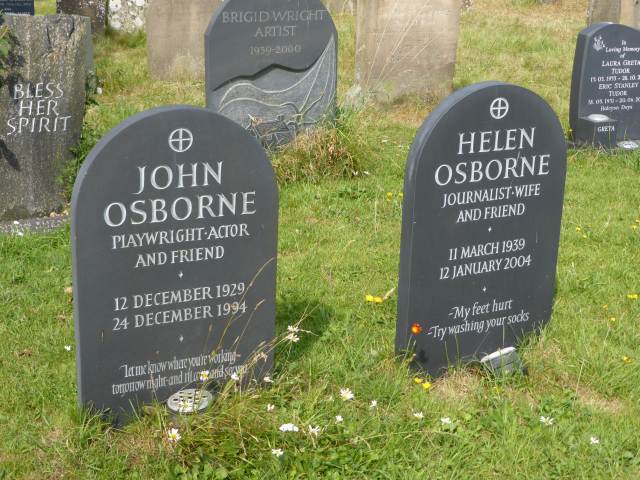
One of the 'attractions' of the area is the grave of John Osborne.  As we got into Clun I saw the cenetery so pulled in find said grave.  It didn't seem to be there but stone told a sorry story.
We then spotted St Georges Church - a dominating presence above the village - and it also had graves in the churchyard including that which we sought, together with that of his wife.  Wikipedia reveals that they actually lived in Clunton rather than Clun..
The church.
The "Caring for God's Acre" approach recognises the importance of churchyards as refuges for wildlife at a smaller scale.  As I have said elsewhere there are a few cemetery trusts in Australia that couldbenfit from this approach.
The artwork here was created by an Abyssinian artist to memorialise the death of Dermot Thesiger the third son of W Thesiger of Milebrook House.  On researching this

  • checking with "A Life of my choice" by Wilfred Thesiger; and 
  • the website for Milebrook House (thank you information lady at Knighton for that information)

I found that Dermot was the younger brother of Wilfred Thesiger whose exploits as an explorer and soldier in the 20th Century have fascinated me for years.
An interior shot of the church.  Again the kneelers are a great splash of folksy colour.
On our way to Rhayader Frances was able to catch this guy managing the verges.  In the really narrow lanes I think they cock the cutter up to prune the hedges.
A couple of shots of the central area of Knighton (or Tref-y-Clwdd).

We wanted to see a bit of Offa's Dyke which formed the border between Wales and England.  This was a small section close to the visitors centre.
The whole dyke is many kilometers long and is one of the long walks of the UK.  We didn't have time to do much walking but were quite amused by these sign posts.

Heading on towards Rhayader we found another tract of open grazing with sheep wandering around (or in some cases sitting in the middle of the road, not moving for cars).
We got to the farm somewhat early, having made good time from Knighton, and the person selling tickets said we didn't need to be in the hides until 2:45, rather than the 2pm we had read somewhere.  So we went to do their Farm Trail.  This gave a good look at the hides from outside.
Somewhat higher up it gave a good look down at Rhayader and across to the hills behind in mind.
The way was well marked.
At 3pm the feeder turned up and started to wield a shovel.
Click on this to get an impression of the flock of kites swirling around as they decide when to come in to feed,  Other pictures of the Kites, and other birds involved are in a separate page.
This was a fantastic facility developed by the owners of the farm.  They are to be congratulated on what they have achieved.

We drove straight back home to finish packing.  My beer tonight was one I picked up in Shrewsbury the previous day.  It celebrates that town as Charles Darwins birthplace.

Bird of the Day:  Not hard.  Red Kite
Building of the day: St Georges Church, Clun.
Garden of the Day: no nominations
Bad taste of the Day: the Catholic priest and his friend who rabbitted on loudly about church local politics most of the time they were in the hide at Gilgrin.
View of the Day: Looking down from the high point at Gilgrin